Throughout the 1960s tensions began to show with France seeking to limit supranational power. However, in 1965 an agreement was reached and hence in 1967 the Merger Treaty was signed in Brussels. It came into force on 1 July 1967 and created a single set of institutions for the three communities, which were collectively referred to as the European Communities (EC), although commonly just as the European Community. Jean Rey presided over the first merged Commission (Rey Commission).
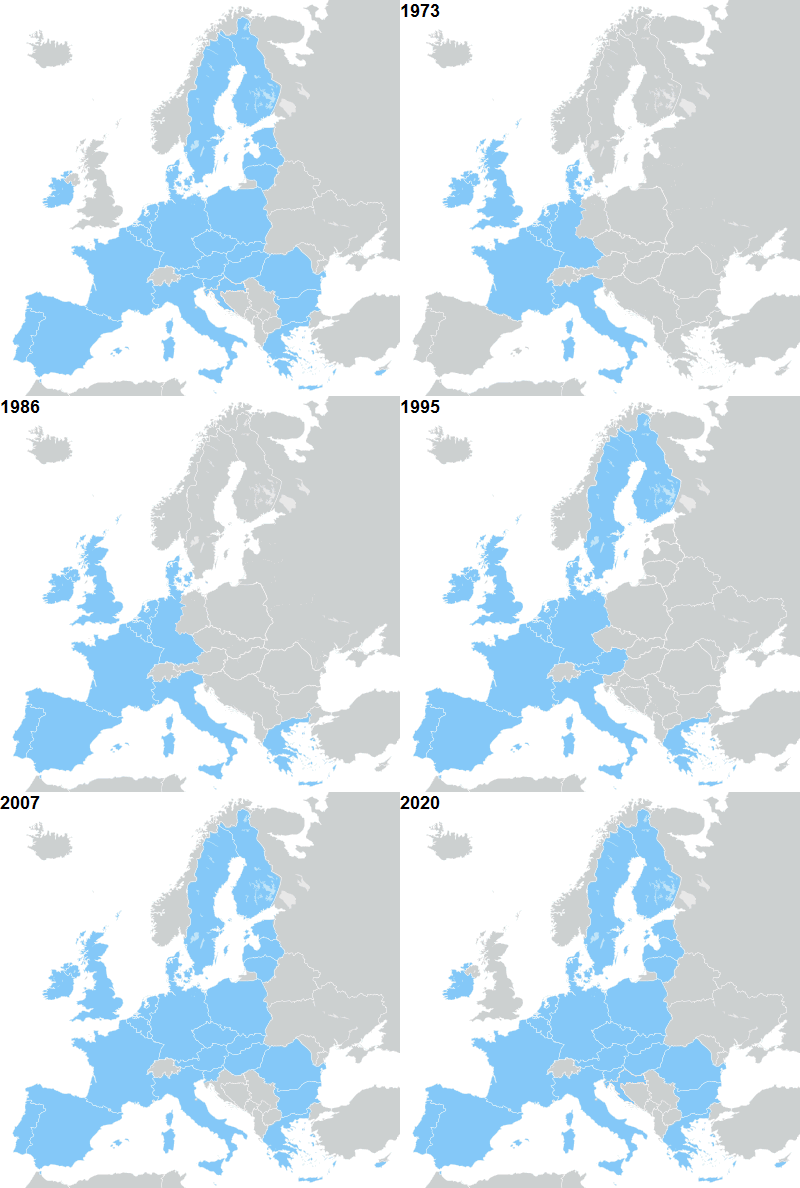
In 1973 the Communities enlarged to include Denmark (including , which later left the Community in 1985), Ireland, and the United Kingdom. Norway had negotiated to join at the same time but Norwegian voters rejected membership in a referendum and so Norway remained outside. In 1979, the first direct, democratic elections to the European Parliament were held.
1. When did the idea of a United Europe come about and why ?
( 1939 - 1945 ) to be a strong economy.
2. Why did Britain not want to join the EEC in the 1950s ?
Because they joined in the commonwealth USA
3. Why did France initially not want Britain to join the EEC ?
Because of the Brithsh US nuclear wepons policies.
4. What is a referendum ?
A referendum is a process that allows (citizens or politicans) to approve or reject a laws or opitions.
5. What percentage of world trade brlongs to the EU ?
16 % of the world tading belongs to the EU.
6. What institutions are involved in the running of the EU ?
The institutions involved in the running of the EU are the European Council, the Council of Ministers, the European Commission, the European Parliament and the European Court of Justice .
7. Which 2 countries joined in 2009 ? Include them on map .
the tow countries that joined the EU are Bolgaria and romania.
8. What are MEPs and how many are there in total ? How many fron the UK
27 , 1
Eurozone crisis
.
What started as a debt crisis in Greece in late 2009 has evolved into a broader economic and
political crisis in the Eurozone and European Union (EU). The Eurozone faces four major, and
related, economic challenges: (1) high debt levels and public deficits in some Eurozone countries;
(2) weaknesses in the European banking system; (3) economic recession and high unemployment
in some Eurozone countries; and (4) persistent trade imbalances within the Eurozone.
Additionally, the Eurozone is facing a political crisis. Disagreements among key policymakers
over the appropriate crisis response, and a complex EU policy-making process are seen as having
exacerbated anxiety in markets. Governments in several European countries have fallen as a
direct or indirect result of the crisis.
1. What does the term ' austerity measures' mean. Find a definition.
An official action taken by government in order to reduce the amount of many that it spend or the amount that people spend
2. Which countries of the EU are facing the greatest crisis?
Graeec , spin , italy , Portugal and Cyprus
3. Choose one of those countries and find out what austerity measures have been made and how these are affecting the citizens of that country.
Greece 1.1 tax increase from 10 to 15 percent